Rabat – The war between the United States, Israel, and Iran escalated sharply Tuesday, with Iranian officials reporting a dramatic rise in casualties and rejecting calls for negotiations as fighting spreads across the region.
According to Iranian state media, citing the Iranian Red Crescent, the death toll from joint US-Israeli strikes across Iran has climbed to 787. More than 500 locations in at least 153 cities have reportedly been hit, marking one of the most extensive waves of attacks in the country in recent history.
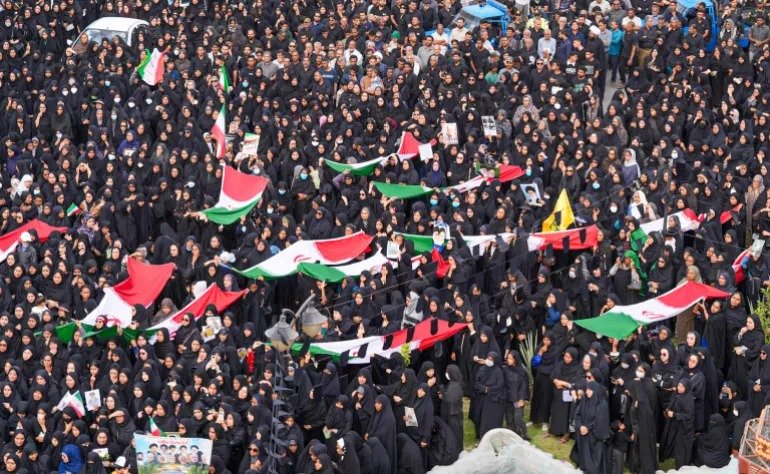
Iranian authorities also held a mass funeral in the southern city of Minab for 165 people killed in a US-Israel strike on a school building. The majority of victims were schoolgirls.
The International Atomic Energy Agency confirmed that recent satellite imagery showed damage to entrance buildings at Iran’s underground Natanz uranium enrichment facility. However, the agency said no radiological impact is expected, and no additional damage has been detected at this time.
Tehran has made clear it does not intend to back down or enter talks under fire. Foreign Ministry spokesman Esmaeil Baghaei said Iran “did not start” the war and that its initial choice was diplomacy.
Read also: Iran-US-Israel War: Trump Accuses British PM of Not Being Helpful
“They must stop the war,” he said, warning that the conflict could soon “engulf Europe” and have global consequences. He urged the international community and the UN Security Council to condemn what he described as aggression against Iran.
Iran has also signaled it will continue retaliatory operations. Analysts say Tehran is targeting sites across multiple countries simultaneously to demonstrate its military reach as well as to send a broader political message that any attack on Iran will destabilize the entire region and disrupt global energy markets. Oil prices have already begun to rise amid fears of prolonged conflict.
Meanwhile, Russia has questioned the central justification for the war. Russian Foreign Minister Sergey Lavrov said Moscow has seen no evidence that Iran was developing nuclear weapons, challenging the narrative advanced by Washington and Tel Aviv.
The war’s ripple effects are spreading beyond Iran. Israel has issued evacuation threats to dozens of villages in southern Lebanon, while Gulf states continue to report attacks and disruptions to key infrastructure.